SHONEN JUMP TREASURE ROOKIE MANGA AWARD #37, JULY 2010 INTERVIEW
Q: What do you pay attention to when writing dialogue?
Sorachi: I write with the hope that I can portray how the characters live outside the manga, outside the panels, and in other places that aren’t shown. Not in a descriptive sense, but in a way that releases a piece of language that opens up the imagination. Without it, it would be impossible to display the characters to their fullest in a few pages.
Q: What do you do to draw characters in an attractive way?
Sorachi: First, I have to make myself like them. Only you can protect a character who is about to be obliterated by the reader. If you have the determination and commitment to do your best to protect them and say, “No, this guy is more interesting,” I think you can create an interesting fellow.
Q: Do you have any ‘tricks’ for drawing a neat ending to an episode?
Sorachi: I’d like to ask myself that, but anyway, as many times as time permits, I reread the story and rearrange the structure. I think you should suffer through the process of polishing to the point of getting fed up. I am sure that such suffering will not be in vain.
Q: What advice would you give to those who are aiming for the Treasure Rookie Manga Award?
You need to work as hard as or, harder than the writers in order to overtake the current serialization team. Think about your manga all day long. You have to love your manga that much. Turn your manga into something that you yourself can appreciate. Let’s all work hard for each other.
SHONEN JUMP TREASURE ROOKIE MANGA AWARD #49, JULY 2011 INTERVIEW
Q: Please tell us about “A character whose appearance was well crafted”, ‘A character with a well-crafted gap’ and ‘A character who successfully created a sense of relatability”.
Sorachi:
- A CHARACTER WHOSE APPEARANCE WAS WELL CRAFTED
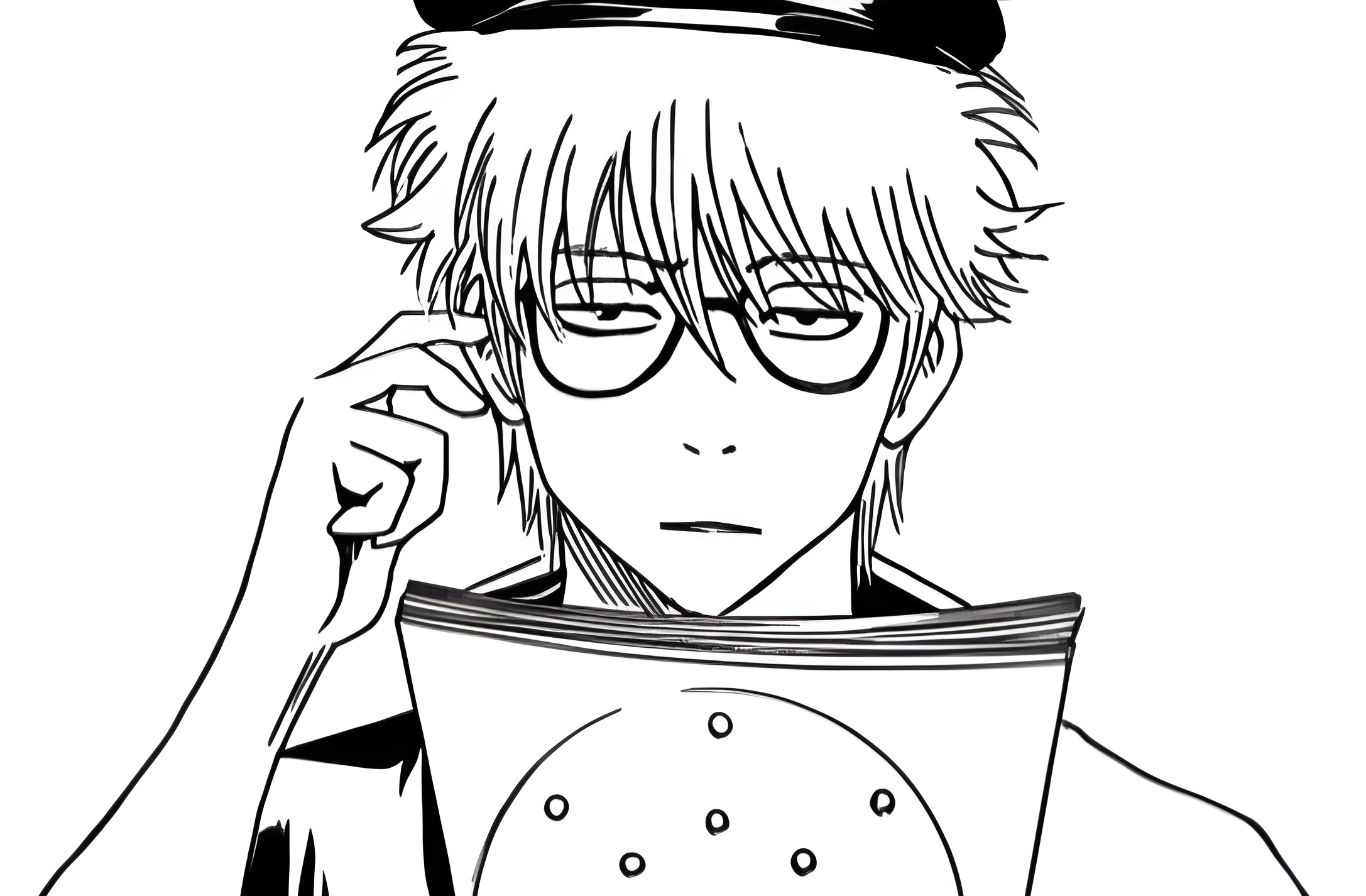
I had a hard time creating the languid impression of Gin-san. A character’s appearance is the first information that readers see, so it can be said to be their foundation. So, without that established image of the character, you won’t notice some differences once they start acting in an unusual way. So, I try to make sure that the character’s appearance is foreseeable to a certain extent, so that people immediately think, “Oh, this is probably the kind of person they are”.
- A CHARACTER WITH A WELL-CRAFTED GAP
Katsura in the earlier chapters. In his case, I first created the base of a samurai-like serious character combined with his appearance, and additionally beat him to a pulp with an exaggerated, off-kilter sense of style. The character was originally a serious character, so no matter how I drew him, there was huge gap, but it was fun. A gap is like a slight saltiness to sugar, and inevitably, a character’s taste will be typological if only the base sweetness is used. Adding a little discomfort, a little saltiness, can enhance the sweetness or create a unique sweetness.
- CHARACTERS WHO SUCCESSFULLY CREATED A SENSE OF RELATABILITY
I don’t know about the readers, but I relate to Kondo and Hasegawa. In a word, they are no-good folks, but I believe that humanity lies in people’s faults and shortcomings, and their flaws are weaknesses that we all have… so I think there are many aspect of their characters that we can all relate to. I try to portray a character who is both pure and appealing, who has charm that overshadows their flaws, and whose flaws can also be seen as charms.
SHONEN JUMP TREASURE ROOKIE MANGA AWARD #63, SEPTEMBER 2012 INTERVIEW
Q: What are the tips to keep in mind when drawing unique characters and works?
Sorachi: Those with more manga experience, be it in terms of characters or stories, have acquired a sense of manga patterns, or manga grammar, based on existing works and rules of thumb. This is an essential part of drawing manga, but simply following a pattern is not enough to create a manga that is unique to you. The first idea that comes to mind is often just a recollection of the pattern, so before originality, I think it is important to first break down the idea and reassemble it using your own brain, whether you are going to follow a pattern or not.
SHONEN JUMP TREASURE ROOKIE MANGA AWARD #98, AUGUST 2015 INTERVIEW
Q: Please tell us what you had in mind when you drew Dandelion, which won the Tenkaichi Manga Award.
Sorachi: I thought that the fastest way to stand out from other new writers was to not do what other people seem to be doing. I decided to stop trying to compete in the fields revolving abilities/techniques and battles and, since I had studied advertising and catchphrases at university, I decided to use words as my weapon of choice. I was fine with losing in everything else, but I set myself the challenge of not losing to anyone in the field of dialogue. There are countless areas in manga where you can be creative, but I think that by being aware of your own weapons, you will be able to see what you need to do and what you don’t need to do.
Q: What are you conscious of in your character’s dialogue?
Sorachi: If I just write the lines that come to mind, they will just be lines that the writer has the character say just to advance the story. I try to make the character speak after carefully examining how they would say the line or whether or not they would really say the line. Even if that derails the story, I give priority to the character. The reader wants to read not just a story, but the story of the characters.
Q: What are some of the things you take into consideration when subverting the reader’s expectations?
There is always a pretense before the surprise. For example, a character who said they were going to get married soon suddenly dies in an accident, or a character who warned their friends climbing a precipice to be careful not to fall over a rock, stumbles over it and falls down first. When I feel that something is wrong, be it a surprise or a gag, it is not so much about the scene itself, but it’s the preceding scene that is not well executed, so I try to go back to that point.
SHONEN JUMP TREASURE ROOKIE MANGA AWARD #110, JULY 2016 INTERVIEW
Q: What do you consider when writing impactful characters?
Sorachi: Even if a character acts chaotically from the viewpoint of the readers, I think the behaviour has to be consistent and inevitable for the character themselves. If you don’t think about the philosophies of life, propensities or other details that led to the behaviour, and what kind of life the character has led because of these, they will just act out of character. So, impact is important, but I think it’s also important to lay the groundwork for the character to fit in.
Q: What do you keep in mind to draw readers in with your characters’ conversations?
Sorachi: I write them almost as if it were a quarrel rather than a conversation. The purpose of a conversation in a manga is to show the reader the characters, rather than to get along with them, so the more you have them disagree with each other, the more colorful they become. A character who only expresses the same opinion as someone else is as good as dead in a manga. I try to think about and understand the desires and needs of each character, and try to create a conversation that expresses their “self” in line with said desires and needs.
Q: And what do you keep in mind when having your characters make fun of each other?
Sorachi: If a character is being laughed at, I try to make the one who turned them into a laughingstock suffer terribly as well. It’s hard to laugh when someone is looking miserable or terrible, so if you bring one character down, you bring the rest with them, or after bringing them, or you bring them down and lift them back up with the rest. Unrelated to mockery, but I also let good characters suffer terrible experiences later on. Readers may not like it when a character’s image gets tarnished, but they also may not like it if it stays the same. I try to keep a balance between the ups and downs of the character’s image and not keep it biased in one direction or the other.
 Yorozuya Shinigami