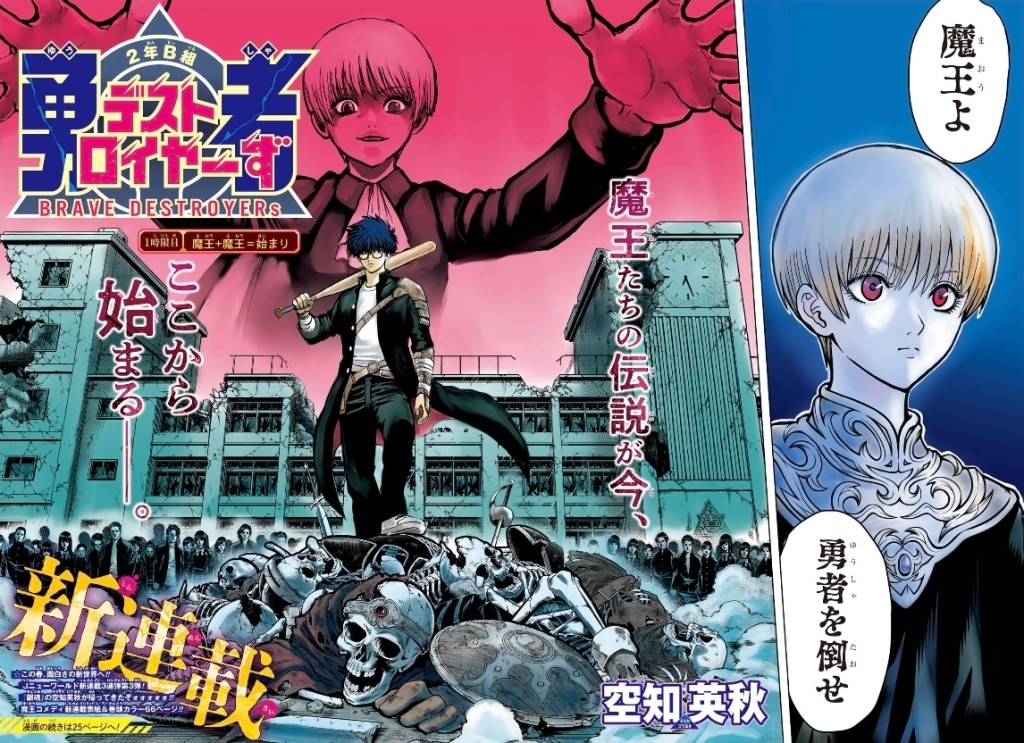
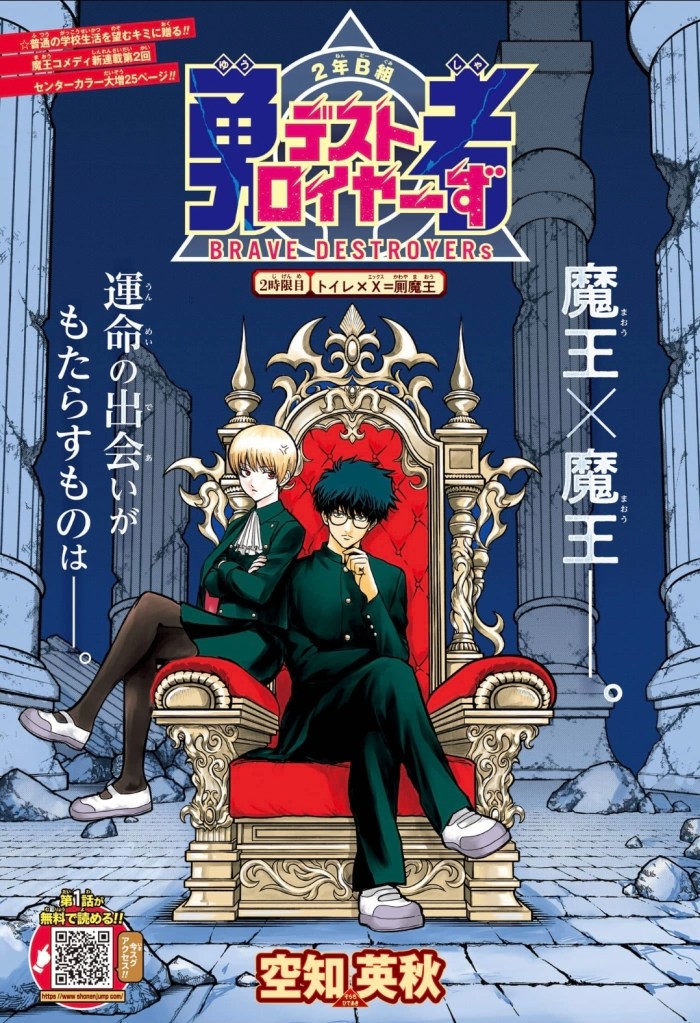
Announced in Weekly Shonen Jump issue 18 on March 29, 2026, Class 2-B Hero Destroyerz (known as 2nen Bgumi: BRAVE DESTROYERs in Japan) is a new comedy manga by Sorachi. The manga officially released on April 20, 2026 in Weekly Shonen Jump issue 21. This manga is the first new project in almost 7 years (precisely 82 months) by the author ever since Gintamam which ended on June 20, 2019.
OVER VIEW (from Manga Plus)
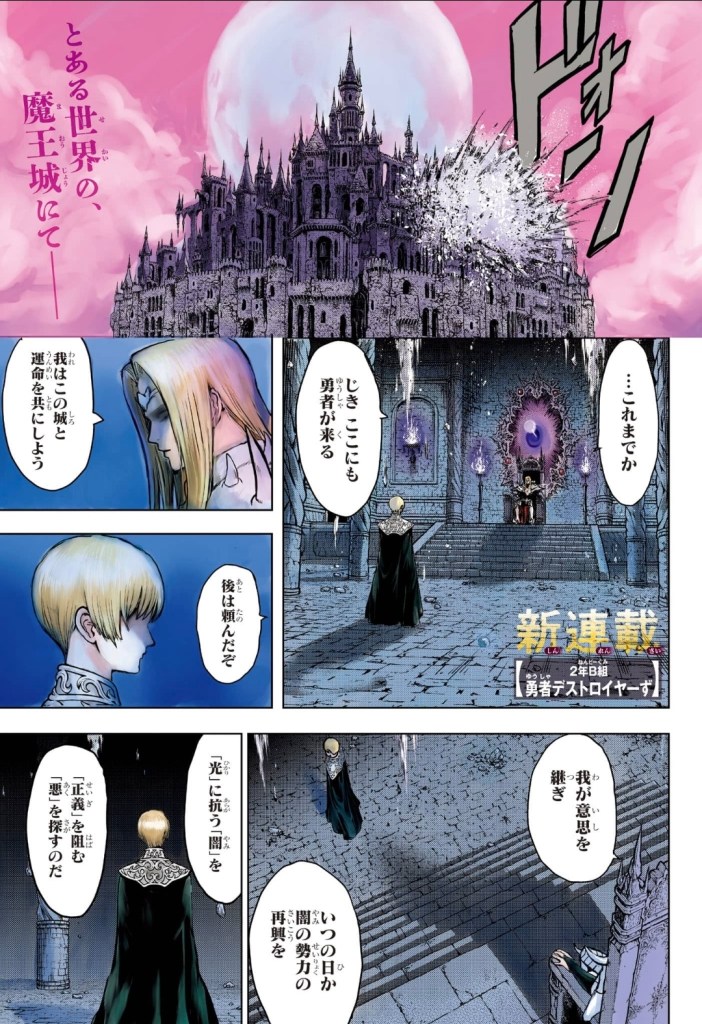
The Demon King who brought darkness to the world has been defeated by the hero, and the light has returned. But the Demon King leaves a part of himself behind as a successor known as Valaris III. To regain their reign of darkness, the new Demon KIng ventures out of the demon castle and heads to our world, but where they emerge is… From the creator of Gintama comes a devilish new comedy!
Comments by Sorachi from the Weekly Shonen Jump magazine’s table of content for Class 2-B Hero Destroyerz
Weekly Shonen Jump issue 21 (April 20, 2026)
“For some reason, I’ve ended up back in hell. I may be an old man now, but I’ll do my best as if I were a newbie”.
Weekly Shonen Jump issue 22/23 (April 27, 2026)
“I just can’t seem to get back into a weekly pace. Actually, I’ve never really managed to meet deadlines properly before either.”
Weekly Shonen Jump issue 24 (May 10, 2026)
“I’m heading back home for my father’s 1st year deathday. Part of me wants to show him my new serialized work, but I also feel like he’ll just lecture me… I offer my prayers*”.
*The word Sorachi used here is “Gassho”, which refers to the Buddhist act of clasping your hands in prayer, often when offering one’s condolences. The term is also used at the end of letters, and thus can be translated to “Yours truly” or “Your sincerely”
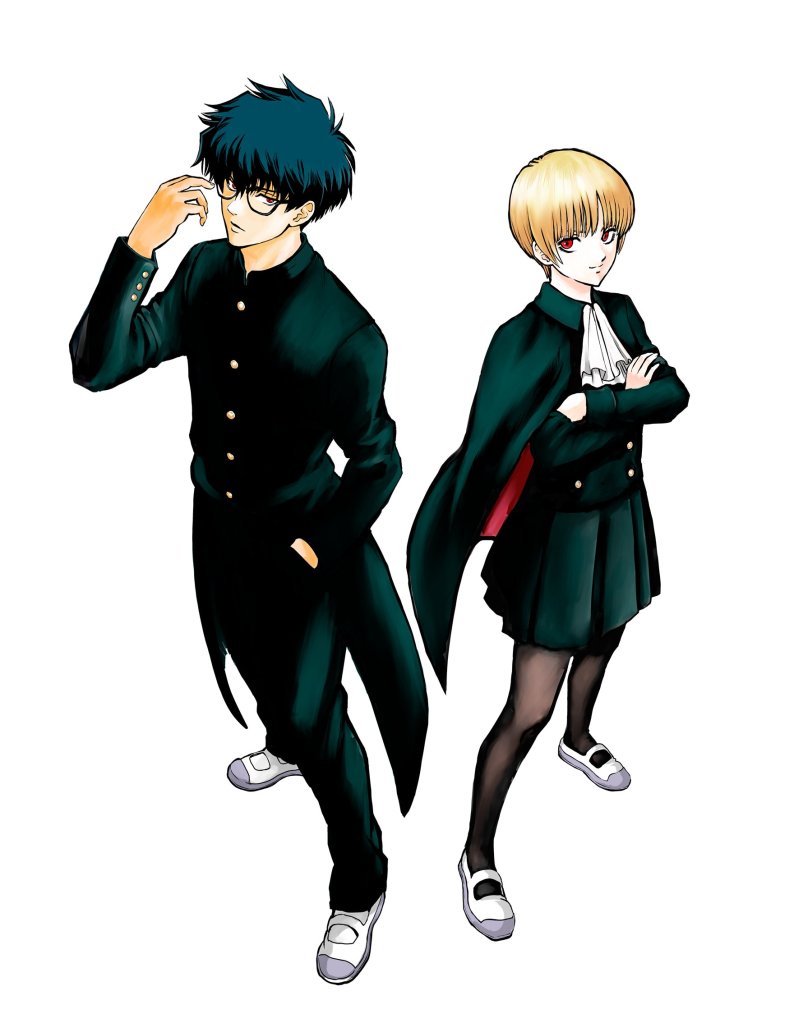
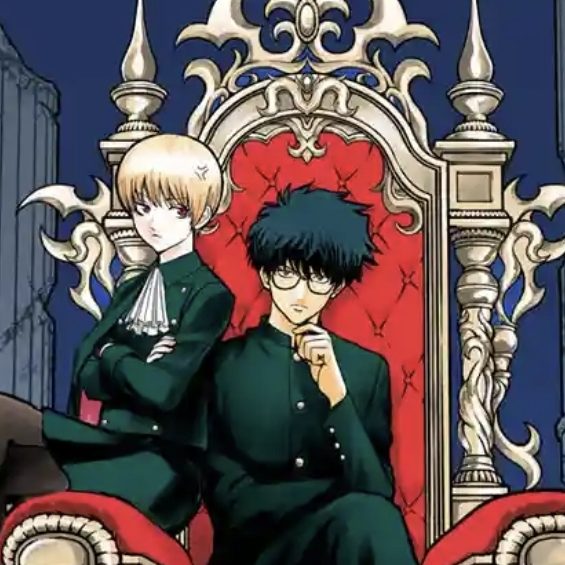
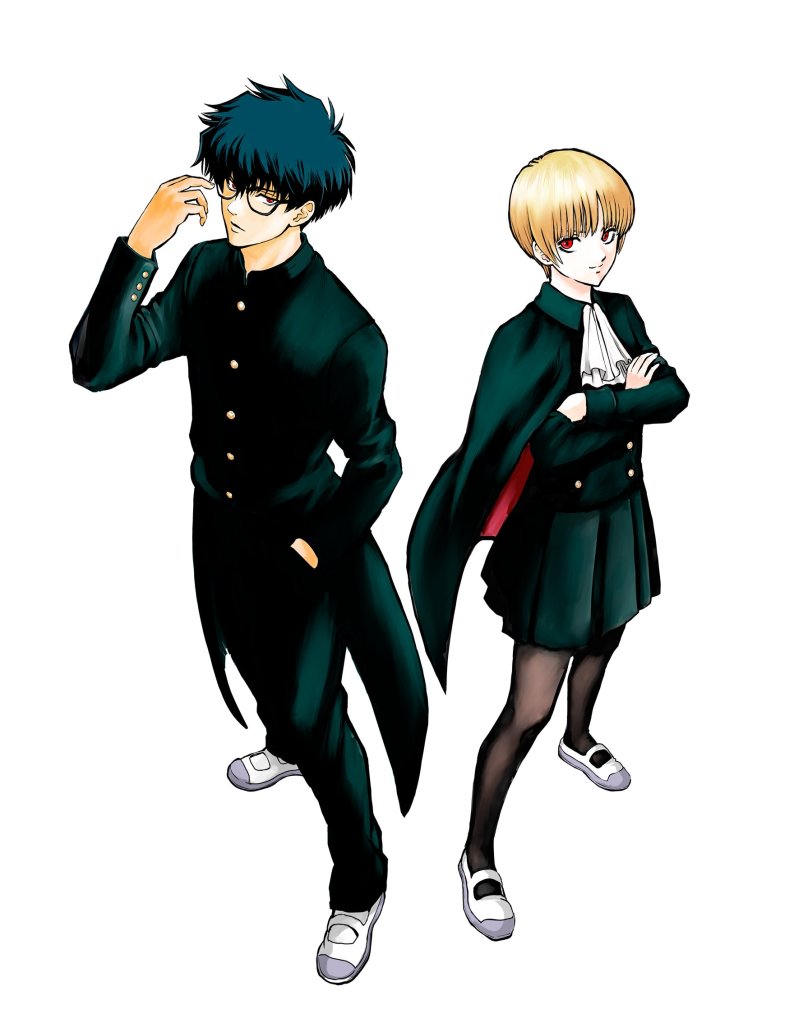
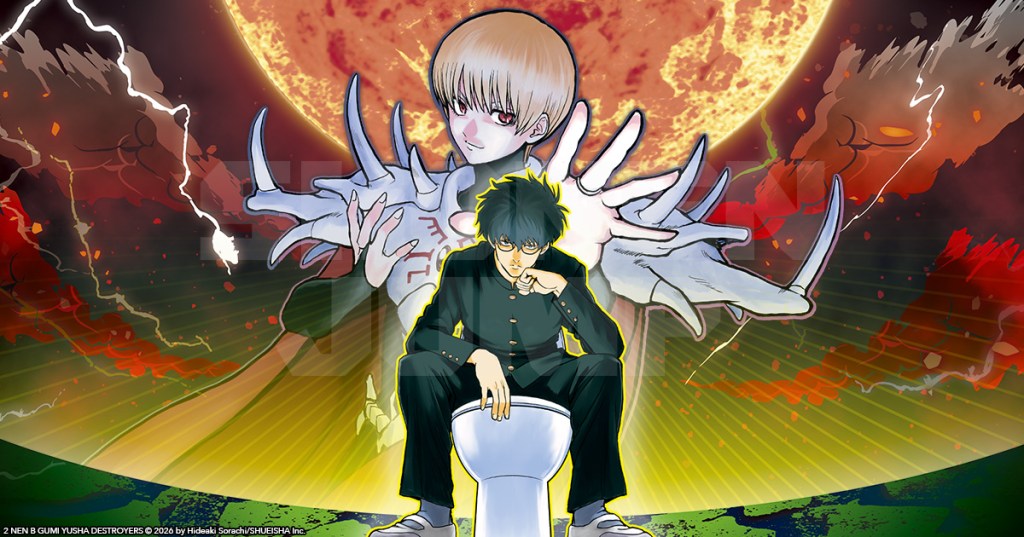
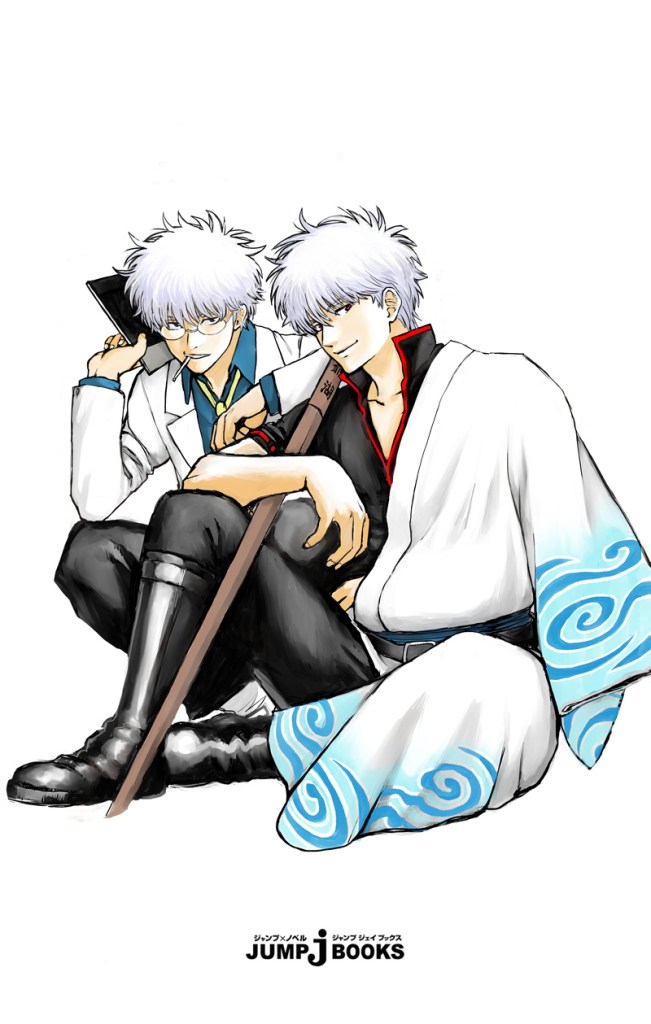
Promotional illustrationWeekly Shonen Jump issue 21/2026Shonen Jump (NA) cover page1st Period color front page1st Period color spread2nd Period color front page
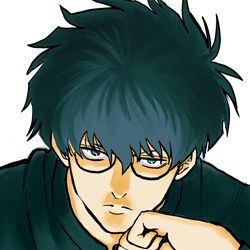
One of the two protagonists, known as Demon King Commode. His name (九門開 in japanese) translates to “Ninth Gate Open”. The surname Kumon itself, originates from that of a guard who protected the Kyoto Imperial Palace’s ninth gate during the Heian period.
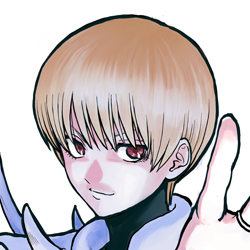
Valaris III
One of the protagonists, also known as the Demon King. Likely inspired by the Dragon Quest IV antagonist Psaro.
A new fan sub group named Silver Soul subs is dedicating itself to provide entirely new subtitles for the entire Gintama anime with fixes, improved translations, and more translator notes on references and subtle jokes within each episode. As posted by user u/SinbadVetra on the Gintama subreddit back in July, people that can work on typesetting, translation checking, editing, quality checking, kfx and more have mostly been recruited. They lacked a translation checker proficient enough in the Japanese language, but they’ve currently found one who can help with that as well. Now, they’re in need of a member who can write a list of as many references and translator notes per each episodes, whose work will also be credited by the team.
If you’re capable of doing such work and would like to participate in this new project in order to contribute to the Gintama community, or even help spread the word by further by sharing this with friends, or other social platforms until new people hop on this fan project, you can join their public server here.
There's a fan project in the works for a new subbed version of the Gintama anime. The group has found most of the needed personnel, and are in need of someone who can write references/tl notes per each episode.
In the Weekly Shonen Jump 36/37 issue that was released today in Japan, the 10th installment in the 3nen Zgumi Ginpachi Sensei spin-off series by Tomohito Osaki, titled, Gintama: 3nen Zgumi Ginpachi Sensei – Come To The School Camp* was announced. This volume, which is the second released ever since the announcement of the anime in 2023, is coming out as a premiere to said upcoming anime which will be releasing in October. The brief summary of the story content released by the official Jump J Books portal found in the volume is as follows:
Ginpachi, Shinpachi & Kagura battle over lost items
There’s a thrilling White Day battle led by the Shinsengumi
Ginpachi somehow finds himself partaking in a part-time job at Ub*r Eats in place of Hasegawa the Madao
Class 3Z go on a treasure hunt during a school trip on a deserted island.
The new volume will be releasing on October 3, 2025 (Fri.), purposely timed with the release of the anime, which despite not having a release date yet, is likely to come out days later, or possibly on the day.
The Gintama spin-off, 3nen Zgumi Ginpachi Sensei, will begin broadcasting in October 2025, and its Blu-ray and DVD release will be releasing early on. Ahead of this release, the anime staff has decided to hold a poll on Gintama’s Aniplex portal, to decide pair of characters will appear on the cover art. The poll begins today, and ends on March 30, 2025 at 11:59 PM (JST). The results will be announced at a later date.
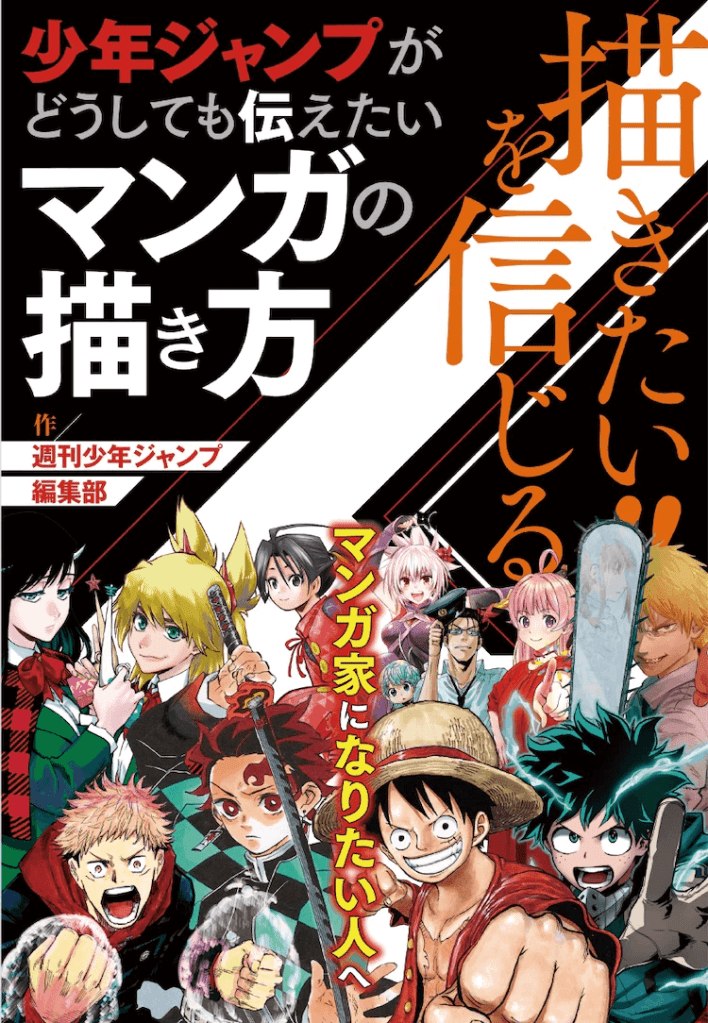
Sorachi’s interview excerpt from the The Shonen Jump Guide To Making Manga book (Official translation by C. Cook from VIZ Media).
What knowledge would have benefitted you when starting your manga career?
We often see publicly available info about how pros with a team of assistants might split up their time and workload when trying to finish a draft, but you rarely see authors doing all that work alone, despite the fact that that’s the reality of it for most new authors. I think a lot of newcomers have their spirits crack under the weight of the overwhelming workload and end up giving up on their unfinished drafts. It would behoove them to hear a bit about the need to be mentally prepared for all that. My first-ever draft had me writhing in agony for half a year. The manga author’s journey is at its most brutal at the start.
What did you do first after deciding to become a manga author (e.g., practicing, strategizing, etc.)? And/or, did you have an efficient way to practice?
Introspection. I analyzed myself and reflected on my best weapons to take into battle (and my worst ones). I decided what I would set out to do (and what I wouldn’t) with as much self-awareness as possible.
What are you mindful of when revisiting your storyboards (either when self-editing or taking advice from editorial)?
I give my storyboards a fresh look and re-examine what role each page will play. For instance, one page might be the “free page” that comes before a big gag. So, which panels does it absolutely need, and which can it do without? I tend to have my metaphorical writer’s camera pulled way back at first, but when I zoom in more and more until the details of the picture come into focus. That’s the best way I’ve found to fix up my work.
Is there any way you could have been better prepared before your serialization began?
Having a stockpile of character designs to draw from in advance. Creating characters from scratch, while working on a weekly series? Woof, that’s rough. Both mentally and physically.
What do you bear in mind when creating a manga (e.g. personal themes and throughlines)?
Sorachi: I’m always searching for the intersection point of what I want to draw and what readers want to read. When there are lots of those intersections, that equals more opportunities to stop and take a breather. But if you only have one of those two lines to start with, you’ll be caught up in one-way traffic and will just have to go with the flow.
What’s your approach to creating strong, memorable characters?
I decide from the start what a given character is allowed to do and what they aren’t, and make the character follow those rules to a T, at first. That’s fundamental. If the author and reader don’t have a basic shared understanding about the essence of a character, then by definition, the author can never do anything shocking or unexpected with the character to win them more fans. Next, create settings and stories that force you to loosen the rules that constrained your character.
Ultimately, I believe readers want to see characters act like themselves at times, but also not, at other times.
How should one practice creating those strong characters?
When you find that you’re fond of someone in life, analyze how your own feelings on them involved. Cases where you were a huge fan of someone from the start are less useful than experiences where you disliked someone at first and they ended up growing on you. For example, there might be some foul, disgusting creep of an actor who’s obnoxiously handsome, but there come those rare moments when he says just the right thing on a variety show that makes you go, “Huh, he’s not bad at all.” At that moment, drop what you’re doing and run that self-analysis to figure out what’s going on in your head. Why’d you hate him originally? What changed? As someone creating characters, you have to be able to control that likable vs. unlikable dial however you see fit.
How long does it take to create the storyboards for a single nineteen-page chapter of manga?
Three to five days.
How long does it take you to finish the full draft for a single nineteen-page chapter of manga?
Two to three days.
Beyond creating your storyboards, what do you do to come up with ideas and plot points for your work?
I consume lots of manga, movies, books, anime, and video games. I take note of story patterns and turn them into my personally stockpile of ideas. More specifically, I write down stuff I find interesting or boring, and then think about why I felt that way. It’s my eternal homework assignment and hobby.
Is there anything you referenced when creating your one-shots?
My grand challenge was being more concise with my stories, so I read all the Akamaru Jump* one-shots I could find and compared how each author approached their page distribution to my own approach, which helped me make progress. The tricks to cutting down on length are knowing when the scene changes should happen, knowing how long to spend on each scene, and cutting everything that can be cut.
*One of Jump’s older sister magazines. Now known as Jump GIGA.
SHONEN JUMP TREASURE ROOKIE MANGA AWARD #37, JULY 2010 INTERVIEW
Q: What do you pay attention to when writing dialogue?
Sorachi: I write with the hope that I can portray how the characters live outside the manga, outside the panels, and in other places that aren’t shown. Not in a descriptive sense, but in a way that releases a piece of language that opens up the imagination. Without it, it would be impossible to display the characters to their fullest in a few pages.
Q: What do you do to draw characters in an attractive way?
Sorachi: First, I have to make myself like them. Only you can protect a character who is about to be obliterated by the reader. If you have the determination and commitment to do your best to protect them and say, “No, this guy is more interesting,” I think you can create an interesting fellow.
Q: Do you have any ‘tricks’ for drawing a neat ending to an episode?
Sorachi: I’d like to ask myself that, but anyway, as many times as time permits, I reread the story and rearrange the structure. I think you should suffer through the process of polishing to the point of getting fed up. I am sure that such suffering will not be in vain.
Q: What advice would you give to those who are aiming for the Treasure Rookie Manga Award?
You need to work as hard as or, harder than the writers in order to overtake the current serialization team. Think about your manga all day long. You have to love your manga that much. Turn your manga into something that you yourself can appreciate. Let’s all work hard for each other.
SHONENJUMP TREASURE ROOKIE MANGA AWARD #49, JULY 2011 INTERVIEW
Q: Please tell us about “A character whose appearance was well crafted”, ‘A character with a well-crafted gap’ and ‘A character who successfully created a sense of relatability”.
Sorachi:
A CHARACTER WHOSE APPEARANCE WAS WELL CRAFTED
I had a hard time creating the languid impression of Gin-san. A character’s appearance is the first information that readers see, so it can be said to be their foundation. So, without that established image of the character, you won’t notice some differences once they start acting in an unusual way. So, I try to make sure that the character’s appearance is foreseeable to a certain extent, so that people immediately think, “Oh, this is probably the kind of person they are”.
A CHARACTER WITH A WELL-CRAFTED GAP
Katsura in the earlier chapters. In his case, I first created the base of a samurai-like serious character combined with his appearance, and additionally beat him to a pulp with an exaggerated, off-kilter sense of style. The character was originally a serious character, so no matter how I drew him, there was huge gap, but it was fun. A gap is like a slight saltiness to sugar, and inevitably, a character’s taste will be typological if only the base sweetness is used. Adding a little discomfort, a little saltiness, can enhance the sweetness or create a unique sweetness.
CHARACTERS WHO SUCCESSFULLY CREATED A SENSE OF RELATABILITY
I don’t know about the readers, but I relate to Kondo and Hasegawa. In a word, they are no-good folks, but I believe that humanity lies in people’s faults and shortcomings, and their flaws are weaknesses that we all have… so I think there are many aspect of their characters that we can all relate to. I try to portray a character who is both pure and appealing, who has charm that overshadows their flaws, and whose flaws can also be seen as charms.
SHONEN JUMP TREASURE ROOKIE MANGA AWARD #63, SEPTEMBER 2012 INTERVIEW
Q: What are the tips to keep in mind when drawing unique characters and works?
Sorachi: Those with more manga experience, be it in terms of characters or stories, have acquired a sense of manga patterns, or manga grammar, based on existing works and rules of thumb. This is an essential part of drawing manga, but simply following a pattern is not enough to create a manga that is unique to you. The first idea that comes to mind is often just a recollection of the pattern, so before originality, I think it is important to first break down the idea and reassemble it using your own brain, whether you are going to follow a pattern or not.
SHONEN JUMP TREASURE ROOKIE MANGA AWARD #98, AUGUST 2015 INTERVIEW
Q: Please tell us what you had in mind when you drew Dandelion, which won the Tenkaichi Manga Award.
Sorachi: I thought that the fastest way to stand out from other new writers was to not do what other people seem to be doing. I decided to stop trying to compete in the fields revolving abilities/techniques and battles and, since I had studied advertising and catchphrases at university, I decided to use words as my weapon of choice. I was fine with losing in everything else, but I set myself the challenge of not losing to anyone in the field of dialogue. There are countless areas in manga where you can be creative, but I think that by being aware of your own weapons, you will be able to see what you need to do and what you don’t need to do.
Q: What are you conscious of in your character’s dialogue?
Sorachi: If I just write the lines that come to mind, they will just be lines that the writer has the character say just to advance the story. I try to make the character speak after carefully examining how they would say the line or whether or not they would really say the line. Even if that derails the story, I give priority to the character. The reader wants to read not just a story, but the story of the characters.
Q: What are some of the things you take into consideration when subverting the reader’s expectations?
There is always a pretense before the surprise. For example, a character who said they were going to get married soon suddenly dies in an accident, or a character who warned their friends climbing a precipice to be careful not to fall over a rock, stumbles over it and falls down first. When I feel that something is wrong, be it a surprise or a gag, it is not so much about the scene itself, but it’s the preceding scene that is not well executed, so I try to go back to that point.
SHONENJUMP TREASURE ROOKIE MANGA AWARD #110, JULY 2016 INTERVIEW
Q: What do you consider when writing impactful characters?
Sorachi: Even if a character acts chaotically from the viewpoint of the readers, I think the behaviour has to be consistent and inevitable for the character themselves. If you don’t think about the philosophies of life, propensities or other details that led to the behaviour, and what kind of life the character has led because of these, they will just act out of character. So, impact is important, but I think it’s also important to lay the groundwork for the character to fit in.
Q: What do you keep in mind to draw readers in with your characters’ conversations?
Sorachi: I write them almost as if it were a quarrel rather than a conversation. The purpose of a conversation in a manga is to show the reader the characters, rather than to get along with them, so the more you have them disagree with each other, the more colorful they become. A character who only expresses the same opinion as someone else is as good as dead in a manga. I try to think about and understand the desires and needs of each character, and try to create a conversation that expresses their “self” in line with said desires and needs.
Q: And what do you keep in mind when having your characters make fun of each other?
Sorachi: If a character is being laughed at, I try to make the one who turned them into a laughingstock suffer terribly as well. It’s hard to laugh when someone is looking miserable or terrible, so if you bring one character down, you bring the rest with them, or after bringing them, or you bring them down and lift them back up with the rest. Unrelated to mockery, but I also let good characters suffer terrible experiences later on. Readers may not like it when a character’s image gets tarnished, but they also may not like it if it stays the same. I try to keep a balance between the ups and downs of the character’s image and not keep it biased in one direction or the other.
QUESTION FROM MR. “KAGURA IS REALLY AN ANGEL”, FROM ISHIKAWA PROVINCE
Hello, Sorachi sensei. Thank you for carrying on the magazine publication of Gintama for fourteen long years! After the final chapter, will the work continue as The New Prince of Tennis? Please tell me!
ANSWER:
Well, it probably won’t continue that long. I am currently making the second chapter that will be published in “GIGA”. As far as the progression of the plot goes, comparing it to the life of a cicada, it’s as if the cicada went back underground for a moment, after spending its last day singing its heart out, and thought, “Did I lock the door?”. How? Don’t you guys get it right? Then, comparing it to Terminator 2, in the scene where Schwarzenegger sinks into some sort of blast furnace with his thumb up after the final battle, it’s as if he reappears, after exiting the blast furnace, and bending his thumb says, “Had I turned off the gas stove?” Huh? Still don’t get it? So, speaking plainly, I don’t get it either, help me!
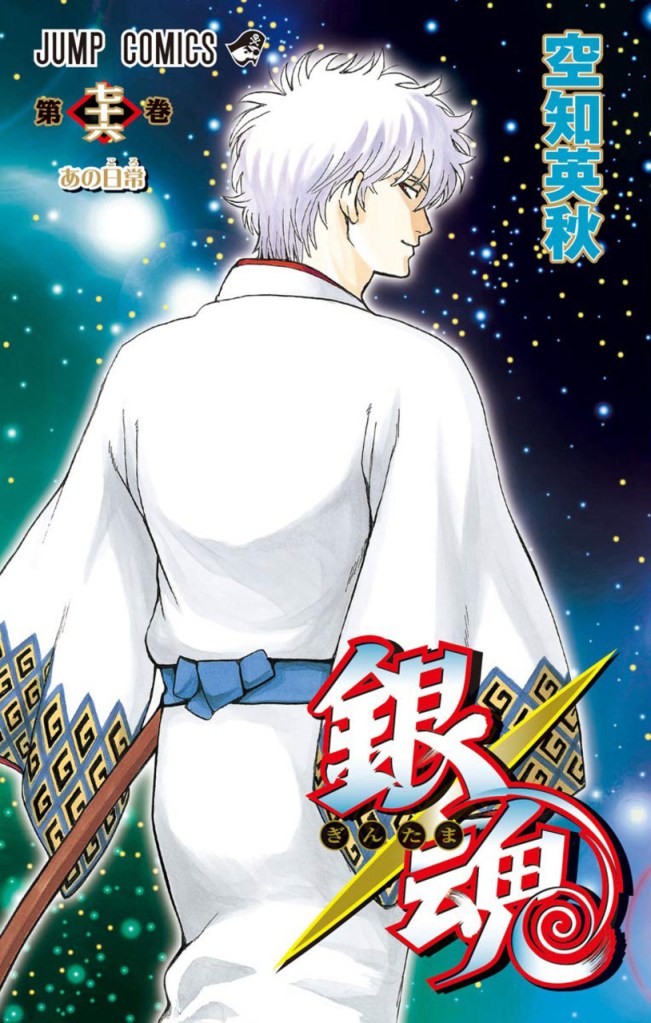
With that said, let volume 76 begin!
CONTACT WITH THE READERS: QUESTION CORNER 284
QUESTION FROM MISS MAYUMI HARAGUCHI, SAITAMA PROVINCE
Gin-san and Shinpachi always use a wooden sword, even when they are fighting and putting their lives on the line. Perhaps it’s because they respect the Haitorei edict? But shouldn’t Shinpachi have inherited a real sword from his father? Anyway, are wooden swords really that strong?
ANSWER:
Shinpachi’s wooden sword was also purchased through “Galaxy TV Shopping”, like Gin-san’s. It is a special weapon, called the “Glasses Crushing Divine Sword”. It is sturdier than an ordinary metal sword and is capable of shattering glasses with a single blow. Anyway, if they use a wooden sword, it’s because they don’t want to kill their opponents, but just knock them out and neutralize them.
CONTACT WITH THE READERS: QUESTION CORNER 285
QUESTION FROM MR. “THE MOON AND THE SUN” OF FUKUOKA PROVINCE
Good morning, Sorachi sensei! In volume 66, when Oboro recalls the past, he says, “Sensei thought I was dead.”… But Shouyo, since he had given his immortal blood to Oboro, shouldn’t he have thought he might be alive, even after being crushed by a boulder? If you could clarify this doubt for me, I would be very grateful!
ANSWER:
Shouyo acted in that way out of the desire to save Oboro from a horrible end, but even though he hoped that thanks to his blood Oboro could escape death, he didn’t think at all that an immortal individual like him could be born. Therefore, he regretted his own thoughtless act, which had turned that little boy into a monster. Maybe that’s why Shouyo didn’t resist when he went to capture him.
CONTACT WITH THE READERS: QUESTION CORNER 286
QUESTION FROM MISS IMAI, TOKYO METROPOLITAN AREA
I’m a dumb seventh grader who wants to draw shonen manga when I grow up. I don’t have any idea if a woman can do it too. If you don’t mind, please tell me!
ANSWER:
There are many brilliant female authors publishing in “Jump,” and all of them draw manga far more manly than those made by their male counterparts. On top of that, they manage to be as delicate as it’s impossible for a man to be. So, I really wish they would all die. I mean, you’re welcome to try, even if you’re a woman, but know that your name will end up in my black book.
CONTACT WITH THE READERS: QUESTION CORNER 287
QUESTION FROM MISS YUINA, AICHI PROVINCE
Sorachi sensei, I’m bad at drawing, especially when it comes to characterizing characters. A friend gave me some advice, “First you have to draw the outline, doing ‘SSSH’, and then proceed with the rest, always doing ‘SSSH SSSH SSSH’… And that’s it!”. I mean, all she said to me was “SSSH SSSH” and I couldn’t understand her at all. Give me some more understandable advice, please!
ANSWER:
First of all you have to draw the outline, doing “ROARRR”, then, if you do “THUD THUD” always doing “ROARRR”, it results in reverse “THUD”, so, if you do “THUD” in that point, it becomes “THUD”.
CONTACT WITH THE READERS: QUESTION CORNER 288
QUESTION BY MR. INUDANGO, FROM HYOGO PROVINCE
Lately, I’ve often been reminded of an incident that made me feel embarrassed, at which point I start to cry out, like “Aaaaah!”, even if it’s not a big deal, but I can’t do anything after that. Does this happen to you too, Sorachi sensei? If I go on like this, I’ll have big problems, I’ll have to prepare for my exams soon, so if you could give me some advice, I’d be very grateful.
ANSWER:
It happens to me too to shout “Aaaaah!”, although the episodes that come back to me are mostly focused on my university period. Moreover, the memories that make me shout “Aaaaah!” increase as the years go by. However, even re-reading Gintama volume 1 makes me shout “Aaaaah!”. We’re all the same. Probably even the great samurai Hideyoshi would shout, “That time I went too far with the sword hunting! Aaaaah!”, and maybe even St. Francis Xavier would exclaim, “That time I cut my hair too much! Aaaaah!” We could say that the history of mankind is a struggle against the “Aaaaah!”. Only that the past from which the “Aaaaah!” arise cannot be changed, so we have only to commit ourselves to build a future without “Aaaaah!”. Building it, however, requires doing “Aaaaah!” properly, without running away from the “Aaaaah!”. Why did you shout “Aaaaah!” at that moment? You have to trace the cause of all the “Aaaaah!” back to never repeat the same thing that makes you shout “Aaaaah!”. Well, I’d say that a 39-year-old giving such an answer is… “AAAAAAAAH!”
CONTACT WITH THE READERS: QUESTION CORNER 289
QUESTION FROM MISS “I WISH KAMUI WORE A PONYTAIL” FROM AICHI PROVINCE
The meeting between me and Gintama happened by chance, when one day I passed by the living room while my sister was watching the anime on TV. At that moment, Katsura was on the screen, but it looked like Goemon to me, so I asked my sister, “Is that Goemon?”, and she said, “It’s not Goemon, it’s Katsura!”. In addition to the aesthetics, the fact that he is being chased by the police also makes him look similar to Goemon… Did I get it?
ANSWER:
Katsura’s character was conceived with a more austere version of Shiryu, the one from Saint Seiya, in mind. He was born after shattering the latter’s image with a hammer and reattaching the pieces with scotch tape. As for the relationship between Katsura and the Shinsengumi, it’s true that it’s based on that between Lupin and Zenigata.
CONTACT WITH THE READERS: QUESTION CORNER 290
QUESTION FROM MR. “GREAT OF UDON WITH BURDOCK TEMPURA”, FROM FUKUOKA PROVINCE
Sensei, had you shown your works to anyone other than the editors of “Jump” before you began serializing Gintama? For example, to your friends, family members, schoolmates…? I’d love to know their impressions.
ANSWER:
I’ve never shown them to anyone, because as a child I had a trauma when my father made fun of me for the manga I had secretly drawn in an elementary school notebook. Only when a self-contained work of mine came out in Jump, I couldn’t help but tell my parents, who were so worried about me since I hadn’t found a job yet. So after reading it, my dad said, “That’s pretty good! Okay, try to go all the way!” as if he was my teacher and not the man who had traumatized me for life. When the second self-contained manga was published, I told him that he didn’t have to give me his impressions back, but even that time the teacher said the right words: “It’s boring and the language used by the girls is too vulgar! Start over!” So I thought of smashing his bald head with a corner of Jump, but since I was being supported by my parents I restrained myself from doing so and wrestled with the pillow in my room. After a while I heard a knock on the door and my dad’s voice from outside, “Um…I re-read the manga and found it funny, you know?” It was obvious he was lying and I could tell he had come to me because he had been scolded by my mother. In short, after witnessing those thoughtful acts on the part of my family, I was even more traumatized.
CONTACT WITH THE READERS: QUESTION CORNER 291
QUESTION FROM MR. “A DEVIL FRUIT APPEARED IN THE LIVE ACTION!” FROM GIFU PROVINCE
I’ve been feeling uneasy ever since the countdown began. At the memory of all those scenes and your great deeds, sometimes I can’t work, and I won’t hide the fact that I often feel like crying… Your figure as you continue to advance on your way, in my eyes, seems heroic like few. You were beside me at all times. There was no need to reach the end, just because this is the last summer of the Heisei era. Your fiery words made my heart throb. Your sorrowful and distressed face made it tighten. The influence you had on me is immeasurable. No one can understand how much energy I received from that person! I couldn’t believe this day would come. I thought everything would go on for eternity. I didn’t even know the word eternity.” There is little time left now, but I will continue to support your exploits until the end and say goodbye to you with a smile. It’s not easy to put into words how I feel, but now the only thing I can say is, “Good job!” and then, “Thank you for everything, Namie Amuro*!”.
ANSWER:
HEY!
That said, the volume 76 special “Goodbye, Namie” ends here. Tell Namie that I won’t make her wait that long, because I’ll be joining her soon too, so let her be ready! When I stand before you… “Can you celebrate?**”
New topic: “Can you celebrate?”
*Popular Japanese singer who retired from her career. **Title of a song by Namie Amuro.