CONTACT WITH THE READERS: QUESTION CORNER 212
QUESTION FROM MR. “GORILLA CLERK”, KAGAWA PROVINCE
I work part-time at a video store. The other day, a customer was looking for Gintama, and as I walked him to the shelf, I couldn’t help but tell him about the appeal of the work. Since then, this customer has been renting the entire series, starting with the first season, and I was really excited about it, so the day he got to the fourth season, I said to him, “You’ve already started watching the fourth season?! How glad I am! How nice!” He hasn’t been seen since. Sorachi sensei, where did I go wrong?
ANSWER:
Your work in spreading the word is unbelievably valuable to me, and I thank you for it, but I would have stopped coming to your shop too. It was fine when you told him about Gintama in the beginning, but I think that was all that needed to be said. I mean, assuming the customer in question had also rented the fourth cucumber from the veranda garden of a lusty married woman living in a council house, maybe you could figure out why. “Has he started watching season four yet?!” … “Huh? This clerk remembers every video I’ve rented?! Then did he also realize that I didn’t get enough of the first, second, and third cucumber and can’t stop anymore?! So, he’s figured out that I’m renting Gintama just to disguise the cucumbers and he’s being ironic?!” … He might think that, right? It’s fine to serve customers honestly, but if you don’t reset your memory, they might suspect you’ve figured out all their tastes and tendencies. In short, it’s like you’ve got them in the palm of your hand because you know their weak points. I think that in a shop like yours, where customers are inevitably displaying their preferences, the salesperson must maintain a certain psychological distance.
That said, 64th obscene Gintama now begins, rolled by a married woman living in a council house.
CONTACT WITH THE READERS: QUESTION CORNER 213
QUESTION FROM MR CHOCOSAND, CHIBA PROVINCE
I have a question for you, Sorachi sensei. Your characters, when they send someone on an errand, very often ask for yakisoba pan. Tell me why! Wouldn’t melon pan be good?!
ANSWER:
There’s a sense in the fact that these are ordinary sandwiches stuffed with noodles. The despicable tone with which they order the unfortunate person to go and buy them, making them exhausted, makes people even more irritated.
CONTACT WITH THE READERS: QUESTION CORNER 214
QUESTION FROM MR. “WHY DID GIN-SAN, DESPITE BEING THE MAIN CHARACTER, COME IN 29TH PLACE IN THE RANKING OF ALL CHARACTERS?”, FROM HOKKAIDO
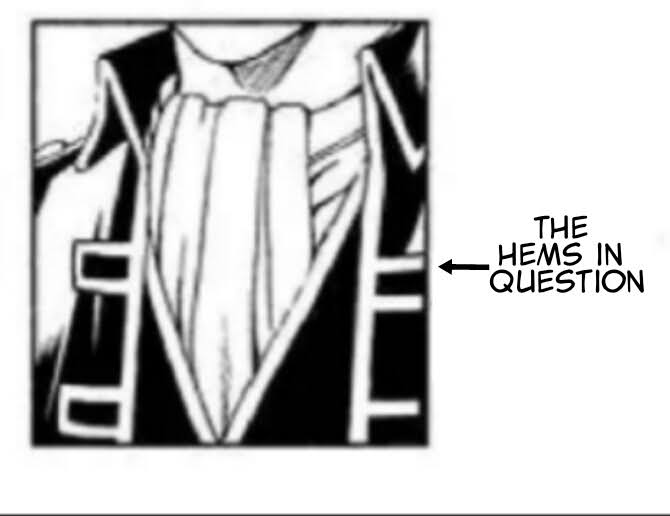
The hems of the Shinsengumi’s uniform are white in the manga, but yellow in the anime, why?
ANSWER:
Rather than yellow, they are golden in the anime, while in the manga they are silver and not white. Since you can see colours on the screen, you generally use colours that stand out to the eye. This doesn’t apply to comics, of course, so I can choose colours that suit the roles of the characters. For example, for the samurai, gold would have been too flashy, so I went for a sober colour. Since I don’t attach so much importance to these details, the staff behind the anime are pretty much free to choose the colours they want. After all, I find it fun to look for colour differences between the manga and the anime!
CONTACT WITH THE READERS: QUESTION CORNER 215
QUESTION FROM MISS “I’D LIKE TO BECOME A STARBUCKS FRAPPUCINO”, FROM THE TOKYO METROPOLITAN AREA
Sorachi sensei, listen to this absurd story. The other day I accidentally spilled milk on the hardwood floor at home and cleaned it with the first thing I had on hand, my father’s towel. When my mother saw me, she scolded me saying, ‘You have to treat other people’s stuff with respect!’ A few days later she happened to spill some barley tea on the floor, and I caught her wiping the floor with such speed that she seemed invisible using… my father’s towel! Just like her! So, I said to her, “You’ve been using other people’s stuff, just like me!” and she said, “But that’s allowed for barley tea. Why is it OK for barley tea but not for milk?! Explain it to me, Sorachi sensei!
ANSWER:
There was a misunderstanding between you and your mother. When she told you to treat other people’s stuff with respect, she was referring to the milk, not your father’s towel. So, she wanted to tell you not to waste the fruit of the cows’ sweat and tears. Whereas barley tea, not only does not spring from the breasts of any animal, but is made trivially from abundant tap water, which smells of chlorine, and produces a negligible amount of sweat. So even if a little is wasted, no problem. The towel, which had previously absorbed your father’s bodily fluids, had no human rights from the start. There goes the misunderstanding.
CONTACT WITH THE READERS: QUESTION CORNER 216
QUESTION BY MR. POEMER FROM TOKYO METROPOLITAN AREA
Sensei, I find Takasugi’s rain poem that appeared in the 573rd lesson a little difficult to understand. What did he want to express? Was he by any chance half asleep?
ANSWER:
After all, Takasugi has a poet’s soul, so what I’m about to do will greatly indignify him, that is, I’ll explain his poem.
“This sky… It looks like it’s going to cry… Did I fall from up there? I try to rummage through my foggy memory. Am I the first drop of rain this gloomy sky couldn’t hold back or the last drop it shed after crying its eyes out, trying in vain to hold on?” Having been in a coma for a long time, Takasugi can’t remember who he is, so he thinks he might be a raindrop that fell from the sky. The first or the last? This passage reflects a dilemma that dwells in his subconscious, between the Takasugi that openly explodes his anger and pain, and the Takasugi that torments himself wondering if it’s okay.
“I could be both or neither. Either way, what’s certain is that I’ve had enough of all this rain.” He does not know which of the two things he is, but he clearly feels that he is fed up with the rain, that is, he does not want to indulge in pain any longer. His poetry expresses these feelings and reveals his true nature, whereas normally he cannot be honest with himself.
CONTACT WITH THE READERS: QUESTION CORNER 217
QUESTION FROM MR. “I LIKE GINTAMA TOO MUCH” OF AOMORI PROVINCE
Good morning, Sorachi sensei! In the 574th teaching, “The Road”, it seems that Takasugi had already discovered the true nature of Master Shoyo/Utsuro, but I just can’t get my head around it. Judging from the plot progression, from Takasugi’s point of view, Shoyo=Utsuro can only be a mere assumption, so the fact that he’s determined to destroy the world created by the “something” that Shoyo Sensei resisted just based on a suspicion seems shallow and questionable to me. Since I like Gintama and Takasugi too much, it’s important to me to resolve this issue as soon as possible. I can’t even work! Please give me an explanation that even a moron like me can understand.
ANSWER:
Since Takasugi is a man of few words, I’ll give you a fuller explanation. Quoting his own words – “Dunno…”, you can tell that he wasn’t initially convinced that Shoyo was Utsuro, but only had a vague doubt about his origins. After he began to carry out his activities against the foreigners to destroy the Shogunate and avenge Shoyo and his comrades, and after getting some information about the Tendoshu clan and Utsuro from Sasaki, Nobume, etc., his doubt grew bigger, until he found full confirmation in the 574th lesson. I imagine that, after awakening from his coma, he was brought up to date on the latest events by Matako and the others as he rushed to Bansai and his comrades and only then came to a definite conclusion. Takasugi’s words express his personal opinion of Shoyo and Utsuro, and reiterate his intent on destroying the world, which has remained unchanged despite the latest developments. All in all, for him, Shoyo and Utsuro, despite having the same body, are two different individuals from the point of view of their inner selves, and the fact that Shoyo died, and he couldn’t save him also remains unchanged. Since the enemies who killed Shoyo are the Shogunate and Utsuro, even though the latter has the appearance of his teacher, he is determined to take him down without hesitation. There you go.
CONTACT WITH THE READERS: QUESTION CORNER 218
QUESTION FROM A GINTAMA FAN, FROM CHINA
Hello, Sorachi sensei! I’m a Gintama fan living in China, attending university in my second year. I have to do a paper for my Japanese language class. I chose the title “Japanese tsukkomi culture in Gintama“. Gintama is a good representation of tsukkomi, the role in traditional manzai cabaret of showing mistakes and stupidity in people’s speech, but lately I have heard from the content that tsukkomi is disappearing. Sensei, what is your opinion of tsukkomi? Can you tell me? Thank you! (sic!)
ANSWER:
Well, a Chinese university student has sent me this letter asking me about tsukkomi, in order to write a paper on Gintama. I think I’d sooner give him a direct demonstration of it… “Well, if it’s for a paper like that, no probleeeeeem!” That’s already an example. Or:
“Think carefully about what you’re going to do, otherwise you’ll have to repeat the exam next year!”, “Where is China trying to go?”, etc… These are all adequate jokes for the purpose. Considering the relationship between China and Japan, the best thing would be to settle everything with one word: Ni hao!
Having said that, the special in volume 64 “The Friendship between China and Japan” ends here. Who knows what will happen between these two countries in the future? Regardless, we’ll try to get along by criticizing and receiving criticism respectively!
See you on the next volume! Ni hao!
New topic: “Ni hao!”
 Yorozuya Shinigami