WE ASKED GINTAMA AUTHOR, HIDEAKI SORACHI
Interview originally uploaded on the Shonen Jump Manga Award portal site
08/04/2022
In response to the question “What did you want to know the most when you first began drawing manga” from last year’s “I want to draw!! How to draw a manga that Shonen Jump wants to convey”, Sorachi sensei said:
“I often see stories about the amount of time and work that professional artists spend with their staff in completing a draft, but I felt that there was little information that touched on the difficulties of completing said draft alone. And even though most beginners do start out alone, there’s many of them who gave up without completing their drafts because the overwhelming amount of work and time involved made them lose heart. I think it’s essential to address this topic as a means of preparing them for the future. For me, it took me six months finishing my draft. The first stage is the hardest for a manga artist.”
We therefore asked Sorachi-sensei for an e-mail interview. He told us about his early days as a manga artist, which was a first for his staff members to hear. Sorachi-sensei is regarded by Gintama fans to have made a great debut with his monthly manga award-winning work “Dandelion” back in June 2002, but it seems, he also contributed works before that…?
Interviewer: First of all, please tell us how you came up with the idea of submitting your work to a manga award.
Sorachi: I had a vague dream of becoming a manga artist since childhood, but I lived in a rural area where G-pen was not easily obtainable. So I would draw manga-like pictures in notebooks with a pencil, but I never got around to actually drawing a manuscript with a pen. I was somewhat detached from manga as I was involved in club activities, but I felt that I could not end my life without seriously working on manga, so I finally decided to draw one during my summer vacation in university. That was my first contribution.
Interviewer: What was the first thing you did when you thought about “submitting” it?
Sorachi: I used to fantasize about my manga ideas during university lectures, so I think I had a story and what looked like a name ready, by the time I started working on it. At the time, I wasn’t very conscious about planning and naming, and I guess I was just doing it at random. That’s why I don’t remember much about it. I had been reading Akira Toriyama’s Hetappi Manga Kenkyujo (The Hetappi Manga Laboratory), so I just relied on the knowledge I gained there, got all the tools I needed, and jumped right in, drawing without any qualms. I had no strategy or anything. So rather than submitting my work for publication or winning an award, I was just trying to see if I could really draw a manga and if I could complete a draft.
Interviewer: Please tell us about the difficulties and memories you had from the beginning of drawing the first work to its completion.
Sorachi: I honestly don’t remember the beginning or the completion of the first work. The experience of creating my first manga was so intense that my memory of the details has been wiped out. All that remains is a sense of defeat. I didn’t understand the enormous amount of work involved until I actually started working on the draft. The tools that I couldn’t use as I wanted. Insufficient background materials. The gap between the ideal picture and the real one. Time wasted like garbage. All I could do was to recover my broken heart and work on the draft. I was in shock. I was shocked at the gap between the vision I had, and reality. What I wanted to do was such a hassle.
Interviewer: How long did it take you to complete the project?
Sorachi: I don’t remember much about that either. But I do remember that I used up all of my planned summer vacation in an instant. It was as if I had gone back in time.
Interviewer: We often hear that beginner artists get confused with manga-specific tools (dipping pens, tones, etc.) when drawing in analog. What was your experience like?
Sorachi: I was not good with dip pens at all. As I mentioned earlier, I used pencils or mechanical pencils to draw manga-like images, but dip pens were a completely different thing. Pencil drawings are made up of multiple overlapping lines, so in a sense, they can be cheated with, because the viewer can choose the best solution out of the multiple lines. With a pen, however, that’s not the case. You have to choose one line and accurately draw it with ink. I was really bad at deciding on a single line, so even if a pencil sketch turned out well, as soon as I put the pen to it, the picture was completely different.
I dislike penmanship even now. I’ve never been able to create a better drawing or penmanship than a draft. I still can’t beat the lines I’ve completed in my brain.
Interviewer: What was the hardest part of the drawing process?
Sorachi: “Backgrounds”, by far. I was really shocked to realize that I had to spend a great deal of time and effort to draw these symbolic pictures that we don’t pay attention to when we read manga, and that we only see for a moment. Most people start drawing manga because they want to draw the characters, and it was hard for me to realize that the most effort and time was being taken away from that. Of course, the backgrounds are an important part of the manga. But I was like, “Did I really work that hard to only get this result?” It’s like, “We worked so hard to get this much done, and that’s all we got? It’s a work that doesn’t seem worth the effort.
Interviewer: What was your self-assessment on the first completed project?
Sorachi: It was a story about a ramen shop that does a side job of exterminating yokai, but I didn’t even keep a copy of the story, and I don’t even remember what it was about since I drew it over 20 years ago. I probably worked on it until the very last minute before the deadline and didn’t even have time to go make a copy. I finished it with just my perserverance, but I thought to myself, “I might not be able to make it as a manga artist.” I had absolutely no sense of accomplishment.
Interviewer: What was your state of mind between the moment you submitted the project and the results?
Sorachi: I had a slight hope that it might be possible, but I heard nothing. So I just assumed that the postman had died in an accident while carrying the draft (laughs). Anyway, I tried my best to fake it and accept it so that it would not be fatal, and that I would not feel completely devastated.
Interviewer: Knowing that the first project was not selected, was there anything you made use of for the second project?
Sorachi: I defended myself by thinking, “The Jump editors must be pretty incompetent if they can’t see my talent (laugh),” but of course I was well aware that they didn’t select my work due to my lack of skills. So I thought, “Well, next time I’ll shorten the story to make it easier for them to read,” or “I’ll be more aware of my strengths and what I want to convey so even idiots can understand it,” and so on. I gradually began to think with the reader in mind, although my attitude was not the best. I finally realized that if I just drew whatever I wanted, the reader wouldn’t understand a thing, and that an artist has to be aware of everything they draw.
I also became aware of my own strengths and weaknesses, and decided what to draw and what not to draw, what to stick to and what not to stick to. I didn’t have time to work on my weaknesses, so I decided to put them off until later and show what I wanted to show first and foremost.
Interviewer: Please tell us about the difficulties and memories you had from the beginning to the completion of the first project.
Sorachi: I thought, “This is where I begin”.
The first work ended up just being tossed around, but I felt that the way I made the manga this time would become the basis for the way I made subsequent works, in both good and bad, and I knew that if I did it with a half-hearted attitude, I wouldn’t be able to get out of that habit.
So, I drew, redrew, over and over again, with the intention of creating not only the artwork but also my own style. I wrote down what I noticed and what I learned while drawing on paper and pasted them all over the room. I thought this would lead to my uniqueness and style. It took me an unusually long time to complete the work because I was doing such weird things, and I probably worked on it for almost half a year. It was hard, but unlike the first work, I was prepared for everything, and I think that made a big difference. I was kind of sitting on my backside. That work was “Dandelion” which managed to win the monthly award.
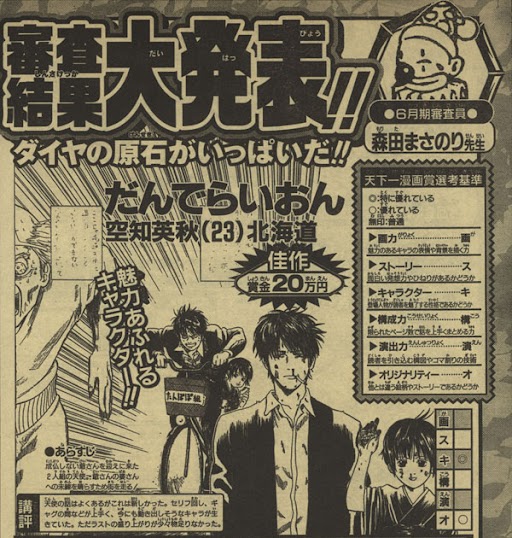
As a result of his ingenuity, Sorachi’s key strengths, such as gags and dialogue delivery, have been highly evaluated starting from here.
Interviewer: How do you feel when you read Dandelion now?
Sorachi: Too wordy. It relied on too much dialogue?
Interviewer: What advice would you give to your beginner self now?
Sorachi: Try using more pictures and direction to create scenes, not just dialogue.
Interviewer: How can one overcome the difficulties of drawing manga alone?
Sorachi: It’s all about ingenuity, isn’t it? It is very difficult to get through a weekly serialization without using all kinds of clever and sometimes even cowardly methods. Making a manga on your own first, is the best way to train for this.
For example, if I were to honestly draw backgrounds for every panel, no matter how many staff members I had, I would never make it in time. Then, where should I draw and where should I leave out? Which angle would be easier to draw from? Is that really the best way to convey the message? It is essential to be creative in this way. Which angle would be easier to draw from? Is that really the best way to convey the message? It is essential to be creative in this way. I feel that, gaining that kind of experience and training your own mindset before you become a professional and have a staff will be a great asset later on. In the end, human beings are creatures that do not squeeze out their smarts unless they are pushed to the limit.
Interviewer: New artists often ask if they should rewrite what they are currently working on because it is starting to feel boring. I think the reason is that manga requires a long period of time of drawing alone and in silence, so they gradually become anxious… What kind of advice would you give them?
Sorachi: I think it is natural to feel bored and to want to redo your work, because I believe that the work of making manga, is the process of polishing and refining your piece until the deadline arrives. If it becomes interesting, you can do it over and over again. But only within the limits of the project and the deadline. It would be better not to turn the project on its head. Think about how you can make it more interesting within the plan, setting, and framework of the manga you are currently drawing. When the deadline arrives, no matter how much I want to fix it, I put down the pen there. If you keep going over and over the boundaries, there will be no end to it, and you will get into the habit of running away from the project and returning to the drawing board every time you stumble.
Interviewer: Likewise, new artists often ask for advice, saying that their drawing skills are not up to par with their images and that they have a hard time making progress. What kind of advice would you give them?
Sorachi: Don’t worry, because the day when you will be satisfied with your art will probably never come, or rather, once you are satisfied, that’ll be the end of it, so please continue drawing and struggling to your heart’s content.
 Yorozuya Shinigami