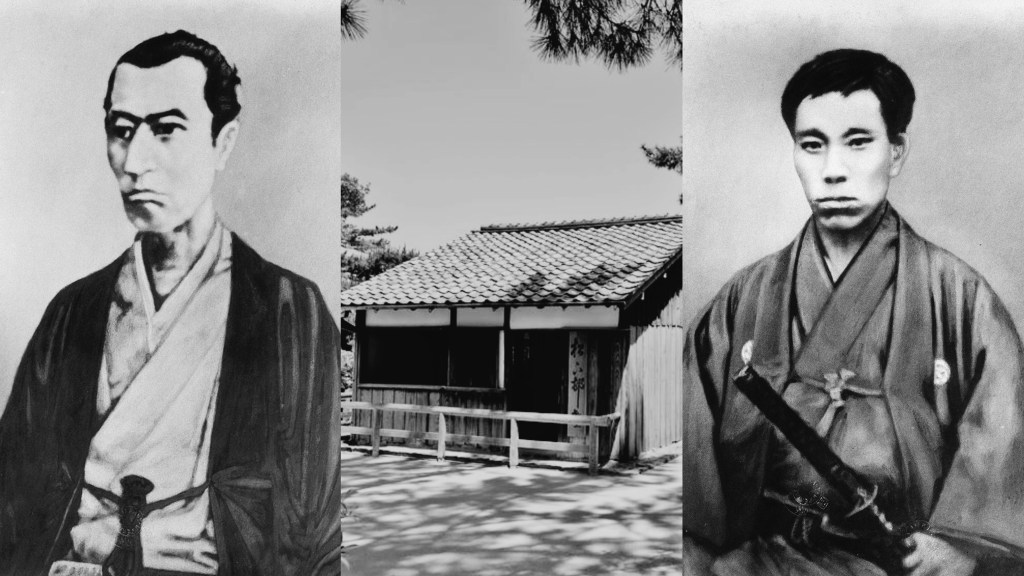
Yoshida Shoin
Yoshida Shoin was born in 1830 into a low-ranking samurai family in the Choshu domain (present-day Yamaguchi Prefecture). While growing up in a poor family, he was admired by those around him for his wealth of knowledge, including lectures on military science to the feudal lord. At the age of only 19, he was able to make a living as a military instructor.
However, times were turbulent at the end of the Tokugawa Shogunate, with the Opium War of 1842, in which the Qing dynasty (present-day China) was defeated by the British after a long two-year war, and the sense of crisis that Japan, like the Qing dynasty, might be attacked by Western nations, began to grow.
Therefore, Shoin Yoshida, who was over 20 years old, set out on a trip around Japan in order to broaden his knowledge. During his trip, he witnessed the American/East Indian Fleet led by Perry in Uraga. Upon witnessing the so-called “arrival of the Black Ships,” Shoin Yoshida decided to sneak onto one of them and stow away in America. …… However, his plan failed miserably, and he was imprisoned in a prison in Hagi (present-day Yamaguchi Prefecture).
Deprived of his freedom, Yoshida Shoin was ordered to stay under house arrest. Many young people gathered at his house, and he opened a private school to make use of his previous experience. The private school he opened at that time later developed into Shouka Sonjuku.
Shouka Sonjuku emphasized the importance of independence
Many people attended Shouka Sonjuku. Among them were many prominent figures who laid the foundation of modern Japan, including Takasugi Shinsaku, Kusaka Genzui, and Katsura Kogoro (Kido Takayoshi), who were active in the Meiji Restoration, and Ito Hirobumi and Yamagata Aritomo, who later served as prime ministers.
The secret of Shoka Sonjuku ‘s ability to produce so many great people lies in Yoshida Shoin’s educational methods. Shoka Sonjuku was attended by not only samurai, but also farmers and townspeople regardless of their status, and although there were over 90 students, there were no monthly fees at Shoka Sonjuku. As a result, those who could not even study in conventional educational institutions were able to have a place to learn.
What is also noteworthy is the class format, which is one of the major characteristics of Shoka Sonjuku. Rather than Yoshida Shoin standing on the stage and lecturing, the students were more likely to have discussions with each other. It is said that the students would engage in heated debates on certain topics, and sometimes students would even take the platform to teach their own classes.
Education at Shouka Sonjuku focused on how to put the acquired knowledge into practice and how to apply it to the future of Japan. From among the students who faithfully inherited Yoshida Shoin’s thoughts and ideas, many outstanding individuals who played an active role in the Meiji Restoration and the new Meiji government were nurtured.
But that is not all. Yoshida Shoin assessed the strengths of each student and taught them to develop their individual strengths, placing emphasis on independence. This educational policy may be one of the reasons why Shoin Yoshida was able to produce so many famous people.
The Ansei Purge
The Ansei Purge began in 1858 (The case in which Ii Naosuke, the tairo* of the Shogunate, and Mabane Akikatsu, the roju**, used their power to suppress those who opposed their plan to conclude a treaty of amity and commerce between Japan and the United States without permission from the Imperial Court). Outraged by this, Yoshida Shoin planned to assassinate Mabane Akikatsu with help from his comrades from the Mito Domain.
In the early morning of 25 May 1859, Shoin was taken from Noyama Jail to Edo in a palanquin, and Shoka Sonjuku was closed down as a result. The reason why Shoin was sent to Edo, was due to the death of Umeda Unpin (a member of the Obama Domain, an Imperialist and expulsionist who was active in Kyoto and heavily criticized the Shogunate) who was arrested during the Ansei Purge, and because he told Shoin that he had met him in Hagi. The reviewing court in Edo questioned Shoin on two issues: what he had discussed with Umeda Unpin and whether he had placed the document in the Imperial Palace in Kyoto, but Shoin’s claims were accepted. Therefore, Shoin saw this as the perfect opportunity to express his opinion to the Shogunate, and he also confessed his Mabane Akikatsu confiscation plan. The officials of the Bakufu Review Office were astonished at the unexpected plan to assassinate the roju. At that very moment, Shouin’s fate was decided.
Shoin, who was prepared after experiencing the attitude of the officials at the review office, wrote the “Eiketsu no Sho” (Book of Eternal Words) for his family, and the Ryukonroku for his disciples in Denmacho Prison (Ryukonroku was replicated many times by his disciples and became a bible for aspiring samurai).
Shoin’s death
On October 27, 1859, he was sentenced to death and executed on the same day. Shoin Yoshida was only 30 years old. Shouin’s calm and graceful demeanor even on his deathbed touched the hearts of those such as Asaemon Yamada, the executor, who recounted the incident in retrospect many years later. The moment he was about to be beheaded, Shoin’s demeanor was truly remarkable. He walked with ease, gave the officials a bow and sat down on the ground. The bakufu officials were deeply impressed by his imposing and unruffled demeanor.
Shoin became a pioneer of the Meiji Restoration, and his thoughts and aspirations, which he passed on to his students with his death, would flourish in later generations.
Shinsaku Takasugi
Shinsaku Takasugi was a samurai, and a royalist from the Edo period, who opposed the Shogunate and became a driving force in the Meiji Restoration. An event that had a significant impact on his future was his enrollment in Shouka Sonjuku, the academy presided by Yoshida Shoin.
At the age of 19, Shinsaku Takasugi was invited by his childhood friend, Genzui Kusaka to enter Shoka Sonjuku. When Takasugi entered the school, he showed his own poems, in which he was confident to Shoin Yoshida, who pointed out that he had talent but was inferior to Genzui Kusaka. That remark by Shoin inspired Shinsaku, who hated to lose, and from then on, he devoted himself to his studies, which were centred around the modernization of Choshu’s military.
Shinsaku, alongside Kusaka Genzui, Yoshida Toshimaro, and Irie Kuichi, were known as the “Four Heavenly Kings of Shouka Sonjuku,” and were held in high esteem by the other students.
Shinsaku devoted himself to his studies and worked tirelessly as a caretaker for Shoin Yoshida, when the latter was imprisoned. However, his father, Kochuta, who did not like Shinsaku’s access to Shoin, asked the clan to bring him back to Hagi. Around the time Shinsaku left Edo for Hagi. It was only after arriving in Hagi that Takasugi Shinsaku learned of Yoshida Shoin’s death. This filled him with grief and anger, since he never expected his mentor to get executed. He then decided to carry on Yoshida Shoin’s will in his heart.
A marriage proposal was arranged by his father, contrary to Shinsaku’s feelings. The idea was to have his only son settle down quickly, and to make him a suitable heir to the Takasugi family. He initially refused, as he planned to not marry until the age of 30, but he went ahead and did so, out of loyalty to his father. He married Masa, the daughter of the town magistrate, but they spent little time together due to Shinsaku’s ever eventful life.
In 1861, Takasugi Shinsaku was ordered to serve as a kosho for Mori Motonori, the successor to Mori Takachika, the feudal lord of Choshu. A kosho was similar to that of an attendant, but only high ranking samurai were allowed to assume this position. Before Shinsaku was appointed, his father, Kochuta, had served the role, meaning both father and son served this role for two consecutive generations. Shinsaku took this opportunity to become fully involved in clan politics.
Around that time, Nagai Gagaku, a Choshu clan official, submitted an opinion known as the “Kouyaku Enryakusaku”, a strategy made for long voyages. This strategy was a proposal that, the Shogunate and the Imperial Court should work together to open the country to the outside world.
Sonno Joi
The Sonno Joi*** movement, which Takasugi Shinsaku and his followers promoted, was to honor the emperor and to expel foreign nations and foreign enemies. Takasugi Shinsaku, along with Kusaka Genzui and others, opposed Nagai Gagaku’s views, which were at odds with the emperor’s exclusionist ideology. Shinsaku was so opposed to Nagai’s views that he, along with Kusaka Genzui and others, intended on assassinating Nagai Gagaku.
Fellow samurai Katsura Kogoro and others, who desired a peaceful resolution, felt uneasy about Shinsaku’s behavior and came up with the idea of temporarily sending him out of the country.
The Shogunate planned an inspection tour in Shanghai around that time, and proposed Shinsaku to be the domain’s representative. Shinsaku heard the proposal, put a halt to his assassination plan, and went to Shanghai.
Shinsaku stayed in Shanghai for about two months from May to July 1862. He was shocked by the sights he saw in over there: a disastrous China which had turned into a Western colony because of the defeat in the Opium War. Shinsaku was driven by the thought that Japan may suffer the same fate as China, if no action was taken. The visit to Shanghai helped Shinsaku in deciding on the path he should take in the future.
Some time after his visit to Shanghai, Shinsaku established a Choshu clan-only organization to promote the Sonno Joi movement and expel foreigners. The plan was to set fire to the British Embassy, which was under construction in Shinagawa at the time, and use this as an opportunity to start a war between the Choshu clan and the Shogunate. The burning was successful, and the British Embassy was set ablaze. However, since the Shogunate did not make much of this incident, the original goal of “the outbreak of war between the Choshu clan and the Shogunate” was not realized.
So as a result, the plan failed.
Takasugi Shinsaku then suggested that it was the time to overthrow the shogunate. However, Choshu administrator, Sufu Masanosuke claimed “It is a decade too early for that” and that they “should wait until that time arrives”. So, within that period, Shinsaku went to live a secluded life in a thatched hut at Yoshida Shoin’s birthplace, Matsumoto village.
While Shinsaku was in seclusion, major developments took place in the Shogunate and the Choshu domain. Under the pressure from the Imperial Court, the Shogunate decided to expel the foreigners. The Choshu domain indiscriminately attacked foreign ships, and for a while, had the advantage, until the Americans and the French launched a fierce counterattack, leading the Choshu clan to suffer several casualties and finding itself in a critical situation.
The daimyo of the Choshu domain, Takachika Mori, decided to summon Shinsaku to help in turning the tide of this difficult situation. Shinsaku proposed the idea of creating an army that would rely on surprise attacks to vanquish the enemy, which Takachika approved of. Due to this turn of events, Shinsaku’s secluded life ended in only 2 months instead of the initially planned 10.
Shinsaku felt that the samurai, who had become accustomed to a peaceful world, could not be a force to be reckoned with, so he recruited a wide range of soldiers regardless of status. This is due to one of Yoshida Shoin’s teachings, which promotes the ideology that all people, regardless of their status, should stand up for the betterment of the world. Takasugi Shinsaku, who faithfully followed his teacher’s lessons, adopted this ideology in the formation of the Kiheitai.
The militia organization “Kiheitai” thus gathered, was founded at the residence of Shoichiro Shiraishi** in Shimonoseki, where Shinsaku became its first Governor-General.
However, Shinsaku’s role as the governor was over after only three months. Reason being, the Choshu clan already had a regular army composed entirely of samurai, so the newly formed Kiheitai, clashed with them frequently. Eventually, the Kiheitai broke into the residences of the regular army’s vanguard unit and killed some of its members. (Kyohoji Incident). This led to Takasugi Shinsaku’s dismissal as governor-general.
Around the same time that the Kyohoji Incident occurred in the Choshu Clan, the “Coup of August 18” took place in Kyoto. As a result, the Choshu clan, which played part in the expulsion of foreigners, was barred from Kyoto. Following the coup d’état in Kyoto, the two forces of the Choshu domain were at odds over how to regain power. Shinsaku was assigned to pursue Kijima Matabei, who led one faction that planned on resolving the inner Choshu conflict through forceful means, however, this did not go well, and he ended up going to Kyoto without the daimyo’s permission, saying that he would see how things were progressing.
After persuasion by Katsura Kogoro and others, Shinsaku returned to the Choshu domain, but the action was regarded as a desertion of the domain. As a result, he was thrown into Noyama Jail, where Yoshida Shoin had been imprisoned before. Takasugi Shinsaku was imprisoned in Noyama Jail for about three months, during which time the Choshu domain was facing a major crisis.
Shinsaku’s death
Takasugi Shinsaku had been suffering from pulmonary tuberculosis for some time, and by the time of the Battle of Kokuraguchi, his condition had worsened to the point where he could no longer stand. On May 17, 1867, Takasugi Shinsaku ended his turbulent life at the young age of 28, leaving behind a farewell poem: “Make the world interesting, even though there is nothing interesting in it.”.
Shinsaku once heard the following words from Yoshida Shoin regarding his view of life and death: “If there is hope of immortality in death, you should always die. If you live to see great deeds, you should always live.” True to his teacher’s teachings, Shinsaku survived despite numerous dangers to his life. And again, as his teacher had taught him, Takasugi Shinsaku passed away, leaving behind his immortal achievements.
Six months after the death of Shinsaku Takasugi, the 15th Shogun, Yoshinobu Tokugawa, offered to give up his position. The Edo shogunate, which had been in power for over 260 years, collapsed, marking the beginning of the Meiji Era.
*Tairo: the office of the chief councillor, and highest administrative post in the Shogunate during the Tokugawa period.
**Roju: meaning Elder. Another high ranking government position in the Shogunate, but below the tairo.
***Sonno Joi: A socio-political movement that advocated the reverence toward the Emperor, and expulsion of the foreigners from Japan.
 Yorozuya Shinigami